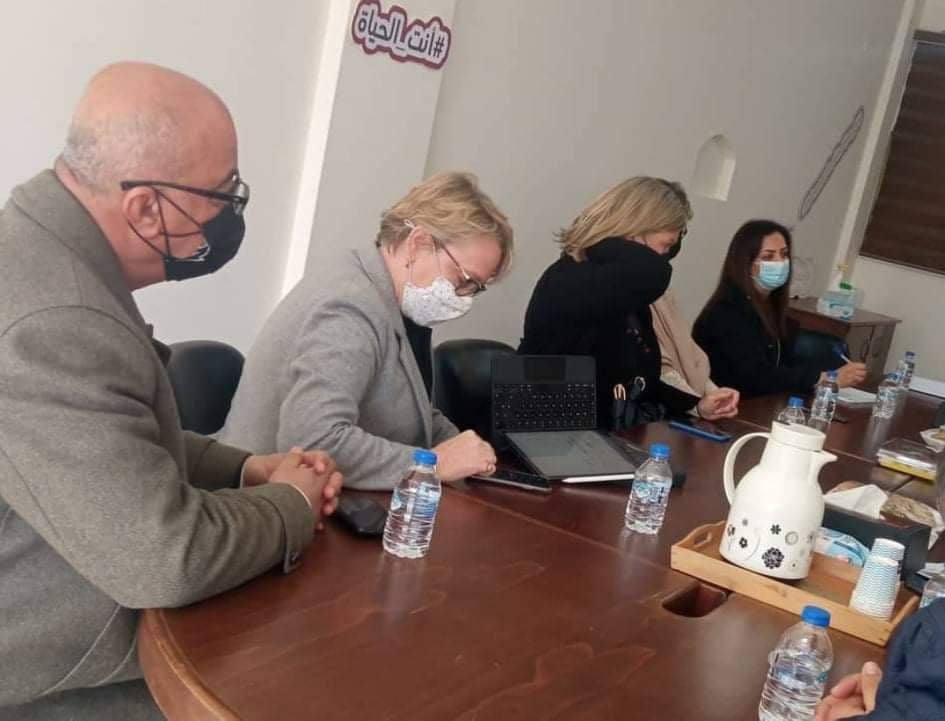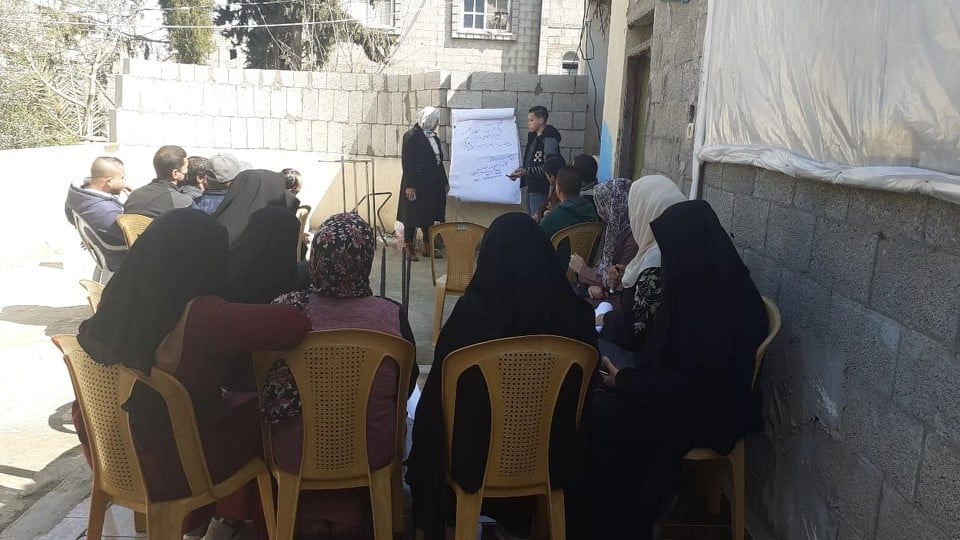
Today, the NGO Network organized a workshop on the advocacy campaign “Reuniting Dispersed Palestinian Families Between the Gaza Strip, the West Bank, and Jerusalem,” as part of the project “Promoting the Contribution of NGOs to the Rule of Law in the Gaza Strip.” The workshop was attended by a number of directors and representatives of institutions, activists, community members, and journalists.
For her part, Zainab Al-Ghunaimi, Legal Researcher and Director of The Center for Women’s Legal Researches, Counselling and Protection (CWLRCP), explained in a working paper she presented entitled “Cases and Issues Deprived of the Right to Family Reunification” that the dispersal of Palestinian families is a direct result of Israeli policies and laws that prevent freedom of movement for Palestinians. She highlighted the current suffering of hundreds of Palestinian families from dispersal and deprivation of stability, where these policies have turned families’ lives from a stable, dignified existence into one filled with separation and deprivation between spouses and children. Women, in particular, are paying a heavy price as a result of these conditions. This suffering is exacerbated by the difference and multiplicity of laws in force in the Palestinian territories and Israeli laws on the other hand, making the issue of family reunification for these dispersed families between the two parts of the homeland, Gaza and the West Bank, as well as the occupied territories in 1948, a painful and complex one.
She also emphasized that the problem of dispersed families lies in three issues: the difference in laws, as the Palestinian people are subject to a different number of laws depending on which part of the three areas they live in (the Gaza Strip, the West Bank, occupied East Jerusalem, and the occupied territories of 1948 – Israel); the enforcement of court decisions; and Israeli laws and procedures. This means that when problems arise in the inability to communicate between spouses, and in the event of divorce, problems arise regarding the rights arising from the divorce and regarding children, who may be permanently separated from the mother, either due to a court decision in accordance with the applicable law or due to the party authorized to implement the decision according to spatial jurisdiction.
Al-Ghunaimi pointed out that The Center for Women’s Legal Researches, Counselling and Protection (CWLRCP), in partnership with the Legal Guidance Center in the West Bank and the Jerusalem Center for Women in Jerusalem, is implementing the project “Dispersed Families in Light of Conflicting Legislations,” funded by the United Nations Development Program (UNDP) and the Open Society Foundations (OSI), through which they seek to shed light on the problems facing these families. The Center has documented (40) cases from various areas of the Gaza Strip, which fall under the dispersal of families between the Gaza Strip and the territories of 1948.