The Center for Women’s Legal Researches, Counselling and Protection (CWLRCP) has concluded the project “Promoting Women’s Rights in Accordance with a Human Rights-Based Approach in the Gaza Strip,” funded by the Secretariat of Human Rights and International Humanitarian Law. The project aimed to strengthen women’s rights and gender equality in the Gaza Strip based on human rights law and international humanitarian law.
Professor Wafaa Helles, the project coordinator, indicated that all project activities were implemented during the six-month project period, from January to June 2015. The project targeted the four governorates of the Strip (North Governorate, Central Governorate, Khan Younis Governorate, and Rafah Governorate).
Helles outlined some of the activities implemented during the project, the most recent of which was the formation of the “Protection of Women During Conflicts and Wars” coalition, in accordance with Security Council Resolution 1325. The coalition was formed to unify the efforts of institutions during wars and conflicts in order to protect women and provide them with material and moral support. She emphasized that the Center will continue its work within the coalition even after the completion of the project and that it will always seek to attract new institutions that will contribute to the success of the coalition’s work. In addition, a media campaign specifically addressing the protection of women during conflicts and wars was implemented within the project.
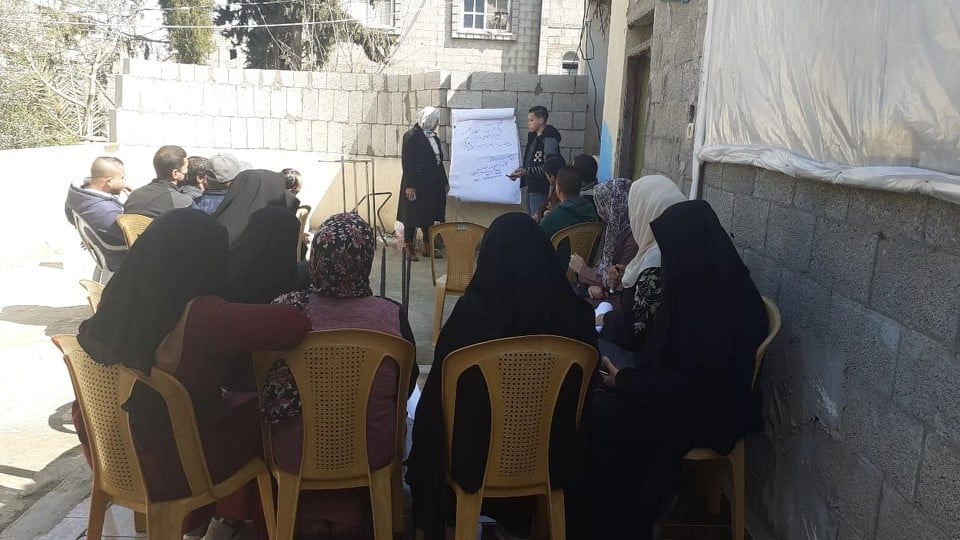
Helles added that (60) workshops were conducted in various community-based organizations, NGOs, and universities, targeting a total of (2090) participants, including (1802) women and (288) men. The target groups were further broken down by age: (864) in the age group (20-29), (511) in the age group (30-39), (443) in the age group (40-49), (216) in the age group (50-59), and (56) in the age group (60 and over). Through these workshops, the Center aimed to raise awareness among the targeted groups about women’s rights and their protection in accordance with international humanitarian law and local laws. Legal consultations were provided, in addition to legal representation before Sharia courts for women, in order to enhance their access to justice and eliminate violence against women.
In the same vein, psychosocial support sessions were conducted for abused women. A total of (40) sessions were implemented, divided into (20) groups over (two days per group), with 3 hours per session, for (305) abused women, including (74) women from the North Governorate, (66) women from Khan Younis Governorate, (75) from the Central Governorate, and (90) from Rafah Governorate. The Center aimed to help these women regain their self-confidence and unburden themselves of the problems and difficulties they face, which in turn brought them more psychological comfort, reassurance, and a sense of security.
Legal assistance was provided to (594) abused women who were targeted during field workshops implemented in the four governorates and through the Center’s counseling unit. This included (542) legal consultations and (52) cases for (38) women who came to the Center’s counseling unit. Work is still underway to follow up on (14) cases for (13) women, in order to enhance women’s access to justice and reduce violence against women.
In addition, (25) lawyers were trained on “Women’s Rights and their Protection in Accordance with International Humanitarian Law and Local Laws” for 40 training hours over eight training days, in order to enable them to become community leaders capable of carrying out awareness and education campaigns.