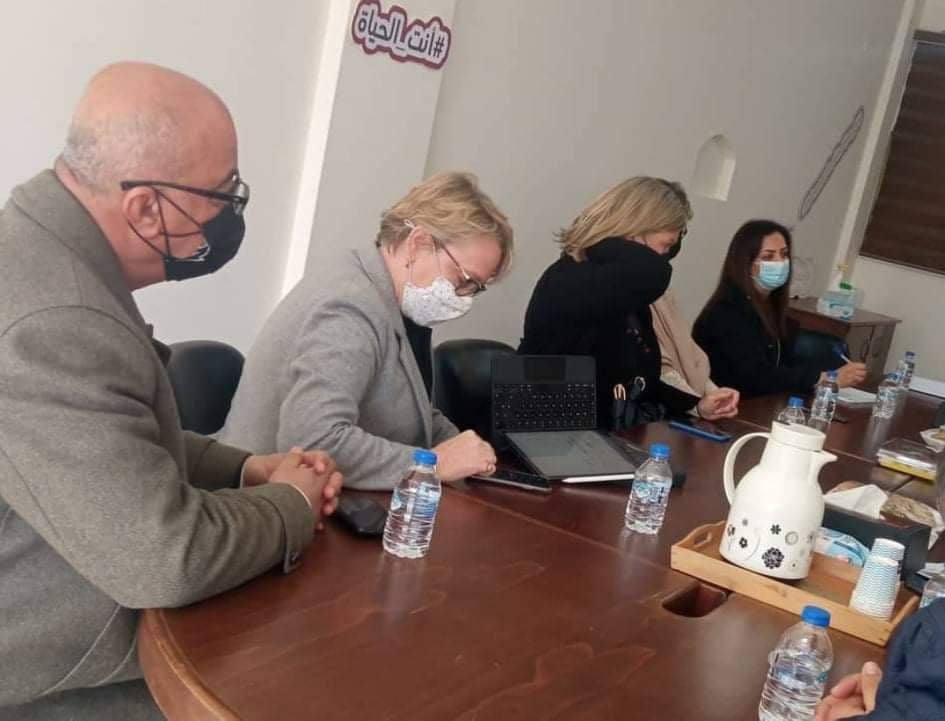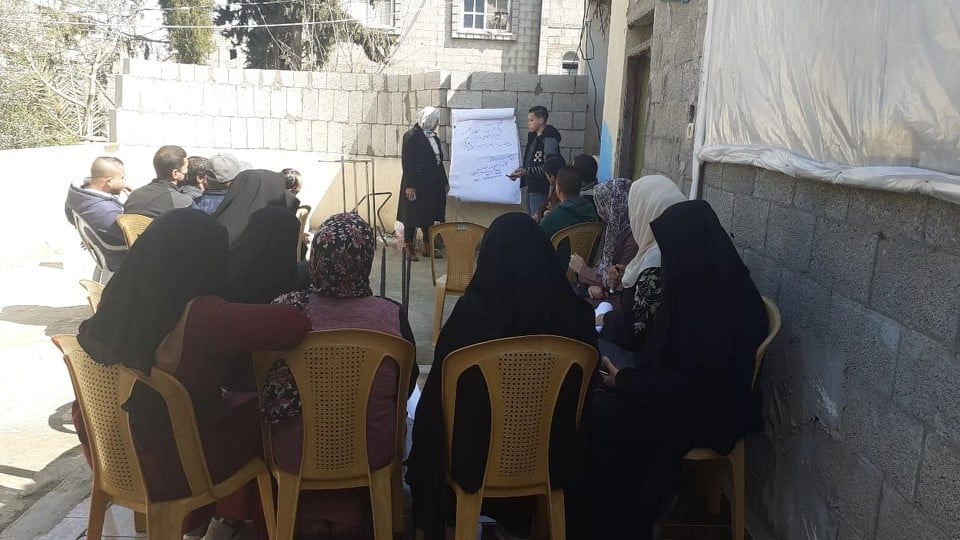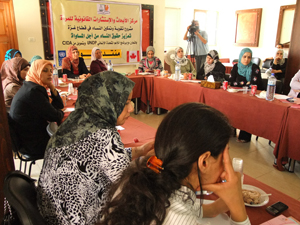
The Center for Women’s Legal Researches, Counselling and Protection (CWLRCP) held a dialogue forum entitled “Women’s Rights and the Consequences of Domestic Violence,” as part of the “Promoting Women’s Rights for Equality” project, in cooperation with the United Nations Development Programme (UNDP) and funded by the Canadian International Development Agency (CIDA).
The forum was attended by a number of community figures and advocates for women’s issues and rights.
Ms. Zeinab Al-Ghunaimi, Director of the Center, welcomed the attendees, speaking about the topics and issues contained in the Personal Status Law, which the Center is working to educate the public, both women and men, about through field workshops implemented by the project team of lawyers, journalists, and social work graduates.
In addition, Al-Ghunaimi explained the important laws pertaining to the protection of women and the guaranteeing of their rights, with the aim of achieving equality and eliminating violence against them.
For her part, Ms. Nadia Abu Nahla, Director of the Women’s Affairs Team, spoke about networking between women’s and community organizations on issues related to women, pointing to the need for developmental indicators and a methodology of work to be agreed upon between various institutions to reach a formulation of another form of collective action.
She explained that coordination and networking are largely present in organizations working in the field of human rights and women’s institutions as a form of pressure groups, and their goal is to influence official bodies, noting that the project’s experience is positive in terms of coordination and participatory work between the four partner institutions that are implementing the project, namely The Center for Women’s Legal Researches, Counselling and Protection (CWLRCP), the Women’s Affairs Team, the Women’s Affairs Center, and the Culture and Free Thought Association.
She called on all institutions, alliances, and campaigns to coordinate among themselves to achieve what women’s organizations seek towards women’s issues, stressing that women’s rights are an integral part of human rights.
Abu Nahla pointed to the risks surrounding collective action, which are represented in the difficulty in making decisions, stressing the need for a memorandum of understanding to reach a decision easily in order to achieve the goals that women’s organizations seek towards women’s issues, explaining that the issue of violence against women cannot be a private file for any institution.
On the same level, the project coordinator, Wafa Halas, indicated during a presentation of the project that it aims to contribute to achieving equality in Palestinian society in the Gaza Strip by improving the level of knowledge of women’s rights as human rights, and increasing society’s sensitivity towards women’s issues and rights, adding that it is considered a qualitative experience because it is implemented in partnership with four women’s institutions.
She added that the project aims to form a trained group of (20) from the target group of the center from various disciplines as youth community leaders working to spread the culture of gender equality, raise awareness of women’s rights and change the negative stereotypical culture towards women, in addition to forming a trained group of (80) women from the target group of the partner institutions to be able to advocate for women’s rights.
The meeting included a number of interventions to evaluate the work between women’s and civil society organizations.