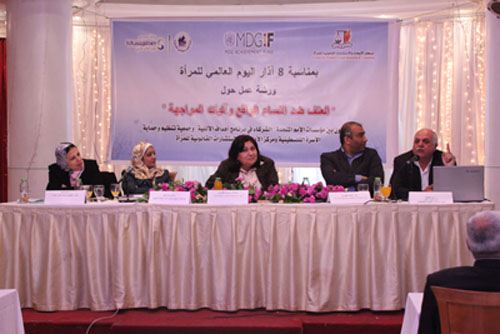
The Center for Women’s Legal Researches, Counselling and Protection (CWLRCP) organized a workshop today on “Violence Against Women: Reality and Confrontation Mechanisms,” which included a presentation of the results of the “Violence Survey in Palestinian Society for 2011,” in cooperation with UN partner institutions in the Millennium Development Goals program and the Palestinian Family Planning and Protection Association. Ms. Zeinab Al-Ghunaimi, Director of the CWLRCP, welcomed the attendees, explaining that the importance of this workshop lies in its discussion of the results of the violence survey in the West Bank and Gaza Strip, especially given the violence the Strip suffers, whether from the occupation or the division.
Natalie Abu Shahla, Program Assistant at the United Nations Population Fund (UNFPA), defined the Fund as an international development agency that seeks to grant every woman, man, and child the right to enjoy a life characterized by health and equal opportunities, noting that the Fund works with governments and other development partners to empower women in rural areas, strengthen health care systems, and develop modern methods to introduce women and girls to their rights.
Mr. Zaher Tantish, Deputy Director-General of the Palestinian Central Bureau of Statistics (PCBS), presented the results of the violence survey conducted by the PCBS for the second time in Palestine in 2011, noting that the first survey was in 2005-2006, and that this survey came to diagnose the reality we live in in the West Bank and Gaza Strip, and that the 2011 survey came based on the 2005 survey in which a database was formed that called for a comparison between another survey, which came in 2011 to find out the latest statistics on violence in Palestine, the most prominent of which was that children in the family are subjected to violence by parents at a rate of 34.5%, and that 37% of women who had previously been married were subjected to violence, while 17% of husbands were subjected to violence by their wives, as it was found that economic violence against women in the Gaza Strip reached 88.4%, followed by psychological violence at 76.4%, and 34.8% were subjected to physical violence, 78.9% were subjected to social violence, and 14.6% were subjected to sexual violence, and all forms of violence at a rate of 51.1%, and these rates are double what women in the West Bank are exposed to.
For her part, Amal Siam, Executive Director of the Women’s Affairs Center, commented on the survey results, considering that these surveys are not analytical in the sense that every figure in this survey needs analysis, and this is our role as institutions to develop conclusions and interventions. She pointed out that one of the advantages of this survey is its monitoring of violence suffered by the targeted groups who were exposed to even one form of violence, and this means the sensitivity of violence to those who were exposed to it, especially targeting husbands in this survey, and this gives a side of credibility to this survey.
Mr. Abdel Moneim Al-Tohrawi, Projects Director at the Palestinian Center for Democracy and Conflict Resolution, presented the “National Strategy to Combat Violence Against Women in Palestine,” and international protection mechanisms under the United Nations and national protection mechanisms. He pointed out that the statistical survey conducted in 2005 and 2011 is one of the forms of mechanisms taken to protect women from violence, and therefore four committees were formed in the Gaza Strip and the West Bank to implement this strategy, namely: the Health Committee, the Studies, Research and Awareness Committee, the Laws Committee, and the Security and Protection Committee. He presented the results expected to be obtained after the implementation of the strategy, which are represented in victims of violence receiving the necessary protection and support and reintegration into society at the national level, a change in the orientations of the various parties within this plan by supporting women’s rights, a change in local laws and legislation aimed at protecting women from violence, a change in the infrastructure of community institutions for protecting women from violence to serve women’s rights, addressing issues of violence against women in the media in a systematic and organized manner, and organizing work between institutions working to combat violence and a practical methodology for exchanging information.
The workshop included interventions by directors of women’s and civil organizations, which were summarized in the importance of these surveys in clarifying the rates of violence and pushing institutions to work to reduce this phenomenon.