**Date: March 1, 2017**
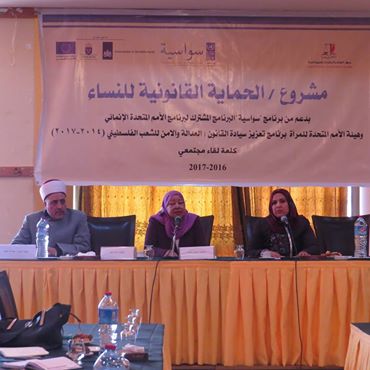
The Center for Women’s Legal Researches, Counselling and Protection (CWLRCP) held a community meeting titled “Towards Equitable and Just Changes for Women in the Family Rights Law.” This activity was implemented as part of the “Legal Protection for Women” project, with support from “Sawasiya,” the Joint Programme of the United Nations Development Programme (UNDP) and UN Women: Promoting the Rule of Law: Justice and Security for the Palestinian People (2014-2017).
Ms. Islah Hassanieh, Chairperson of the Board of Directors of the CWLRCP, opened the meeting, welcoming guests from women’s and community organizations, lawyers, and journalists. She noted that the purpose of the meeting was to present several legal issues that the Center has been working to address in order to reduce violence against women in society. These issues remain pending with official institutions, including the Sharia Court in Gaza and the Legislative Council. Specifically, the meeting aimed to highlight the issue of activating the khula (divorce initiated by the wife) ruling and demand the abolition of the judicial circular issued by the Sharia Court, which relates to the husband filing a claim of discord and dispute, and raising the age of child custody for divorced women to 15 years.
Hassanieh called for the necessity of working to protect divorced women and their children legally, psychologically, and socially, and raising the age of child custody in favor of the divorced woman who has refrained from marriage, in accordance with the best interests of the child. She stressed the need to unify Palestinian laws and legislation, and to have a unified personal status law for the nation that combines originality and modernity and responds to all emerging changes and problems for men and women within the framework of rights and duties. She affirmed that these demands will only be achieved if the Palestinian Sharia judicial institution is unified by working to end the division and achieve national unity. For her part, Ms. Huda Naim, a member of the Legislative Council in Gaza, recommended the necessity of making a legal amendment to the khula provisions contained in the Personal Status Law to remedy the shortcomings (especially granting the wife the right to request khula judicially) and make the texts consistent with the provisions of Islamic law. She recommended the need to consider the draft amended law on khula, which includes:
She pointed out the need for Sharia courts to commit to quickly resolving khula (redemption) cases within an active lawsuit management program that ensures an end to procrastination and stalling by the husband and his relatives. For his part, His Eminence Sheikh Dr. Saeed Abu Al-Jubeen, a judge of the Supreme Sharia Court in Gaza, affirmed that the main reason for issuing the judicial circular regarding the husband filing a claim of discord and dispute against his wife was due to the emergence of many cases in which the wife insults and beats her husband in the corridors of the Sharia courts or other means of discord and dispute. He stated that the percentage of cases filed by the husband and decided in the Sharia courts was eleven cases compared to two hundred and five cases by the wife during the past year (2016), which indicates the scarcity of such claims, as the percentage is almost non-existent in the man’s claims compared to the volume of cases filed by the wife. He pointed out that this circular regarding the -man’s claim- is different from what concerns the woman, as there is no repeated complaint as is the case for the woman, and if the wife proves her claim, she has all her marital rights as if he divorced her, and the matter is not referred to the arbitrators. As for the husband, if the harm is proven, the matter is referred to the arbitrators to determine the percentage of each of them abusing the other in estimating the dowry. For her part, Ms. Wafaa Halas, the project coordinator, presented the most important activities and outputs that were achieved during the project implementation period, in addition to presenting the most important qualitative success stories that were also achieved for the benefit of a number of abused women. On the same level, Ms. Tahani Qassem, coordinator of the studies and research program at the Center, presented the most important outputs and achievements made by the Center for Women’s Legal Researches, Counseling and Protection during recent years.